Every click, swipe, and voice command you perform is propelling AI’s march forward. Deep learning, often dismissed as tech jargon, serves as the linchpin. Behind those virtual assistants, predictive traffic alerts, and even automated medical diagnoses, deep learning exists. It’s not some magical, mystical concept.
Here’s a simpler view: it’s teaching machines to discern patterns as humans do, and then learn from them independently. Our goal is to traverse beyond the hype and into the realm of practical use. Through this exploration, we will unravel deep learning, examining its applications and demonstrating how it is fundamentally reshaping numerous industries.
Neural Networks in Action: The Revolution in Image Analysis
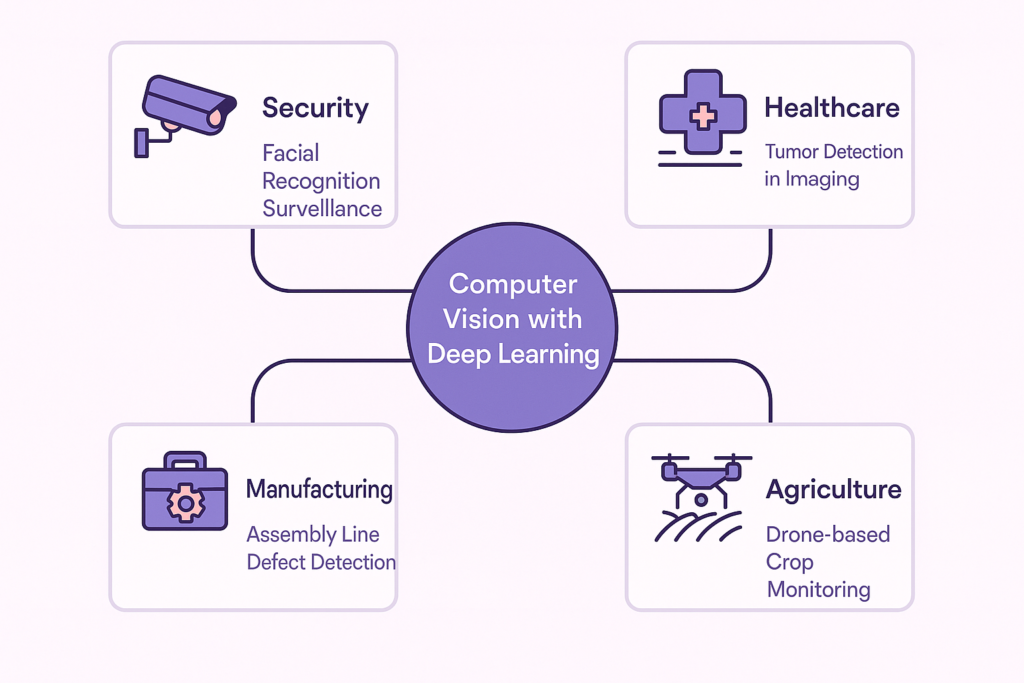
In the realm of image and video analysis, convolutional neural networks (CNNs) have been a definitive game-changer. Imagine creating a security system that can accurately recognize faces, even amidst a crowd. Or visualizing a technology for autonomous vehicles that can readily identify objects on the road, distinguishing pedestrians from traffic signs. Or even consider a medical imaging solution capable of detecting anomalies like tumors in X-rays or MRIs with surgeon-like precision.
All these applications are not mere figments of our imagination but tangible realities established by CNNs. Antiquated are the days of laborious manual feature engineering; today, we delegate this task to our deep networks. Rather than handcrafting every detail, we allow them to learn patterns and features directly from the data. This shift in strategy has considerably amplified their efficiency, capabilities, and societal impact.
Essentially, by leveraging deep learning and convolutional neural networks, we’ve handed off the baton from human-led, detailed engineering to machines capable of intuitive, automated learning. The revolution is already underway, and it’s utterly reshaping how we perceive and interact with the world around us.
Vision Systems in Action
Remarkably, every flaw on a factory conveyor belt can be pinpointed — not by human eyes, but by the scrutiny of computer vision in quality control. Retail storerooms no longer rely solely on manual checks; instead, they employ deep learning algorithms to monitor customer movements and shelf stock levels. Farmers look to the sky, no longer for rain, but for drones that analyze crop health using aerial images. Today, security systems can identify suspicious activity, thanks to intricate neural networks. Each instance showcases the transformative role of deep learning in various industries, elevating mundane tasks to levels of precision and accuracy beyond human capabilities.
Language Unlocked: The Power of Deep Learning in NLP
Language, like a labyrinth, reveals its secrets not in isolated words or sentences but in the intertwined context of phrases and their surrounding text. Enter deep learning, its guiding torch in the convoluted maze of linguistics. In particular, recurrent neural networks (RNNs) and transformer models like BERT and GPT help computers navigate this complex terrain.
Now, machines can not just parrot human language but actually comprehend it, responding coherently and even generating meaningful language themselves. We’ve moved substantially from the rudimentary rule-based methods that tried to compress language into a rigid set of laws. Instead, we’re in a new era where contextual meaning is learnt from the flow of language itself.
Think of it as learning a foreign language. First, you start with learning vocabulary and grammar rules, but soon you realize it’s not enough. You need to understand the nuances, the idioms, and the culture behind the language to truly use it effectively. And that’s exactly the leap that deep learning allows machines to make in natural language processing – from mechanical repetition to nuanced understanding.
The Two Faces of NLP: Gains and Hiccups
When it comes to applying deep learning techniques in the realm of natural language processing (NLP), the story is one of breakthroughs and road bumps.
Pros:
- The art of sentiment analysis has been revolutionized, with systems proficiently dissecting customer feedback beyond the literal words and zeroing in on the underlying emotions.
- Machine translation has improved leaps and bounds, transcending the simple word-for-word approach to convey meaning accurately across languages.
- The sophistication of chatbots and virtual assistants has spiked, raising the standard of automated customer service interactions.
- Document summarization has evolved. It’s no longer about blunt truncation but context-preserving, relevant concentration of content.
Cons:
- Training data often mirrors societal prejudices, leading to biased and unjust outputs.
- Training large models levies a serious computational cost, which isn’t always feasible for smaller businesses or projects.
- Deep learning systems still struggle with the subtlety of human humor and sarcasm, resulting in clumsy interactions or misinterpretations.
- The steady rise in content generation by AI systems raises ethical questions. The boundary lines between human creativity and AI mimicry could blur, impacting ownership and originality.
The tale of deep learning in NLP is still unfolding, with both its marvels and its limitations shaping the narrative.
Demystifying Predictions: Deep Learning’s Role in Analytics and Forecasting
Why do we amass piles of data if not to extract usable knowledge from it? Yet, traditional statistical methods often stumble in identifying complex, non-linear patterns lurking within our vast reservoirs of data. That’s where deep learning steps in with a Sherlock-like prowess.
In the world of time-series forecasting, deep learning models sift through elaborate sequences, gleeful in their complexity, and unmask future trends with startling accuracy. They’ve become somewhat of a secret weapon in sectors like finance, where predicting future market movements can be the difference between staggering losses and sky-high profits.
Ever wondered how some online platforms seem to know you better than you do? Personalized recommendations, which are common applications of deep learning in AI, can feel uncannily accurate. Behind these spot-on suggestions lies the brainwork of deep learning algorithms that extrapolate your preferences from the jigsaw of your browsing history, clicked links, and purchased items.
Turning to anomaly detection, a sudden spike in a customer’s transaction volume may seem as peculiar to statistical models as a penguin in a desert. Yet, deep learning treats it as a clue, connecting the dots with other unusual behavior to flag potential fraud. In this manner, deep learning protects customers and businesses alike from damaging scams.
Shaking off the shackles of predictability, deep learning embraces complexity and chaos, fishing out insights that a human mind, or even traditional analytics tools, might struggle to unearth. Tellingly, it’s the apparent randomness and non-linearity of our world that deep learning feeds on, transforming puzzling connections into an encoded understanding of what’s likely to come.
Revolution in Various Industries via Deep Learning
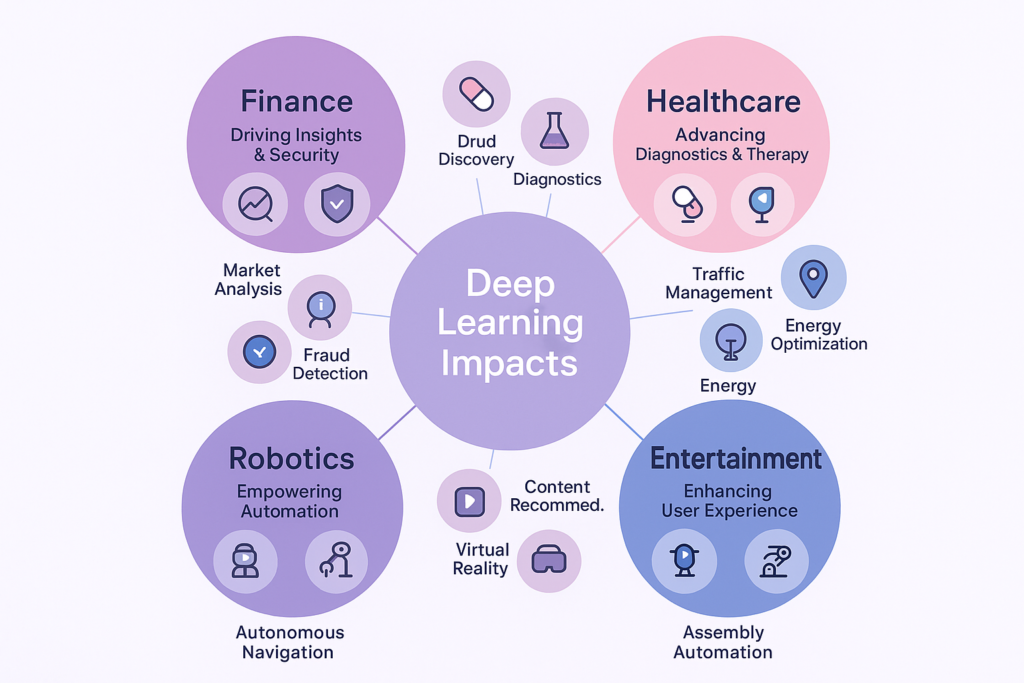
From identifying who’s likely to default on a loan to treating rare diseases, deep learning benefits multiple industries. In healthcare, it advances personalized medicine, aiding in drug discovery and diagnostics. For finance, it analyzes market trends and flags fraudulent transactions – examples which are common applications of deep learning in AI.
Cities smarten up using deep learning for traffic optimization and energy management, while in the entertainment industry, content is recommended and deepfakes aid in special effects. In the realm of robotics, reinforcement learning facilitates complex tasks, signaling the dawn of a new era.
The Challenges Ahead: From Data to Ethics in Deep Learning
Deep learning systems come with their share of challenges. The first is their hunger for heaps of data. These systems require enormous datasets to learn effectively, and collecting these datasets isn’t always easy or ethical. The second challenge lies in their computational needs; they chew through computer resources, sometimes reaching the point of unsustainability. The third challenge surrounds the explanation of their own decisions; often, it’s difficult to comprehend how a deep learning system arrived at its conclusion – the notorious ‘black box’ problem.
More concerning, perhaps, are the moral dilemmas that surface alongside these technological hurdles: discrimination, privacy invasion, and even job displacement. The potential for bias and discrimination is significant if deep learning models mishandle diverse datasets. Privacy concerns arise when personal data is used to feed deep learning algorithms. The fear of job displacement is real as automation advances.
Therefore, striking a balance between leveraging the benefits of deep learning and mitigating its challenges is essential. It’s an area ripe for exploration: how do we responsibly harness the power of deep learning without stumbling over its hurdles? Essential work lies ahead, dedicated to paving the way for ethical, effective, and equitable implementations of deep learning in AI.
Harnessing Deep Learning: A Practical Approach
Implementing deep learning in your field? It matters to begin with a distinct problem that needs resolution. Don’t aim for deep learning merely to have it.
Got data? Deep learning thrives on large datasets. Ensure you have adequate data to feed your algorithms.
Deep learning projects have a knack for missing the mark. Initiate a small-scale project first. Quick iterations and improvisations are your way to go, reducing risk in the process.
Next, make a call on whether to build a team in-house or partner with a company adept in deep learning. Both have distinct advantages, so weigh this decision carefully.
Lastly, but highly crucial, is to factor in ethical considerations from day one. Deep learning can lead to societal shifts. Therefore, it’s important to strike a balance between its practical value and potential impact.
Decoding Deep Learning’s Profound Legacy
Let’s rewind and reflect. Deep learning, we’ve seen, goes beyond mere technological innovation. It charts a new pathway, a novel method to unravel complex issues that span diverse industries. From computer vision’s task of visual perception, natural language processing, which decodes and generates human language, to predictive analytics forecasting unseen patterns – deep learning orchestrates a symphony of transformative shifts.
Yet, this potent tool requires deliberate and judicious use. Ensuring ethical deployment and strategic application, not just yield efficiencies but fosters trust and sustainability. The grand narrative of deep learning is as much about harnessing massive potential as it is about navigating its impactful journey with responsibility and foresight. Recognizing its capacity to revolutionize and disrupt is central, but so is acknowledging the need for equilibrium between ambition and consequence.