It’s tempting to equate artificial intelligence (AI) doing math with a high-powered calculator. This, however, is a misconception as misleading as it is widespread. The truth is that tackling advanced mathematics demands something a calculator lacks and humans profoundly possess, understanding. It goes beyond mere computation to involve comprehension, abstraction, and problem formulation.
Even so, AI’s performance in this arena isn’t a straightforward narrative of inadequacy. Throughout this article, we’re going to dissect this fascinating dynamic, examining how AI navigates the labyrinth of symbolic AI, computational math, and mathematical reasoning. Despite its limitations, AI’s adventure in the math classroom is both intriguing and illuminating, potentially reshaping the future of AI in education.
AI in Math: Mastery or Misconception?
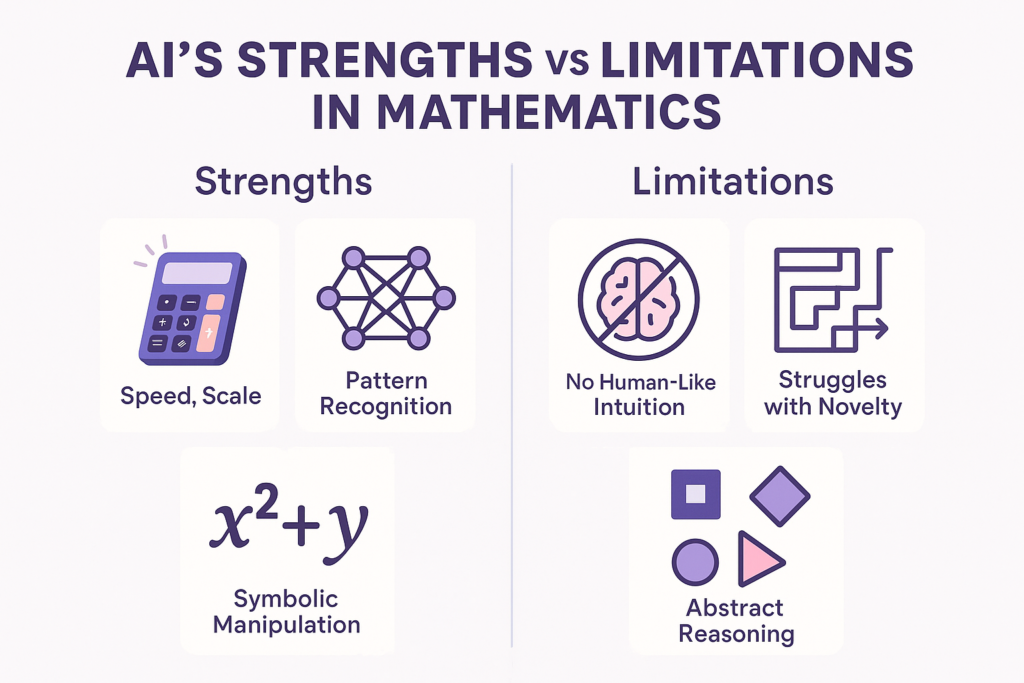
We often hear about AI’s prowess in solving complex mathematics problems. Here, let’s separate fact from fiction.
Myth 1: AI can solve any mathematical problem. In reality, AI shines in tasks of pattern recognition and data-driven calculations. Symbolic manipulations such as those in algebra or derivative calculations in calculus are consolidating its portfolio. For example, suppose you feed it a string of calculus derivatives; it’d crunch through them without blinking.
Yet, ask it for a novel proof in number theory, or to derive a conceptual understanding—AI would stumble. It’s not built to imagine or innovate, but to follow established rules and patterns vigorously.
Myth 2: AI understands math as a human does. A casual nibble on this myth reveals its fallacy. AI processes symbols and data, much like a high-speed, turbocharged calculator. Unlike us, it can’t ‘grasp’ the underlying principles or the abstract concepts that enfold them. A human mind can visualize and understand the logic behind a mathematical concept while AI merely processes it.
As we decode AI’s blossoming romance with advanced mathematics, it’s clear that AI serves its purpose with defined limits. Its abilities extend in predetermined pathways—carefully crafted by humans. Even though it makes strides in computational math and symbolic AI, it falls short of mimicking the unpredictable and creative nature of human mathematical reasoning.
Can large language models or generative AI bridge this gap? As we move further into the future of AI in education, that remains a poignant question.
AI is Quick, Not Human-Like
Don’t get fooled by the impressive speeds at which artificial intelligence (AI) processes mathematical tasks. Contrary to the common line of thought, AI doesn’t ‘understand’ the mathematical principles, but rather, it ‘computes’.
When fed colossal datasets, AI doesn’t flinch or fuss. Thanks to neural networks and large language models (LLMs), it breezes through these computations with speeds unheard of in human cognition. Understandably, this remarkable blend of speed and scale lends AI a certain brute force advantage. It excels especially in intricate tasks like numerical analysis, optimization challenges, and the art of identifying trends in complex data, otherwise elusive to human analyses.
However, it’s worthwhile to remember that the AI’s role is not to mimic human understanding but to serve as a tireless ‘computational assistant’. By doing so, it not only boosts efficiency but also lets humans focus on conceptual understanding, thereby potentially reshaping the future of AI in education.
AI’s Mathematical Limitations: When Creativity and Insight Take Center Stage
Mathematics isn’t just about resolving equations or plugging numbers into formulas. It’s also about inventing new theorems, understanding the ‘why’ behind a solution, and adapting to completely novel problem types. These tasks not only require deep mathematical intuition and creativity, but also a high degree of abstract reasoning. For all the strides AI has taken in brute force computations and pattern recognition, when it comes to these nuanced areas, it hits a ceiling.
Even with its extensive training data, AI cannot wander off the beaten path, challenge norms, or engineer groundbreaking concepts, unlike humans. This inability to navigate the murky waters of abstraction and creativity is its Achilles’ heel when it comes to truly mastering advanced mathematical concepts. It underlines the importance of human insight, which remains a key driver in finding innovative ways to solve complex, novel mathematical challenges.
Therefore, while AI may be a handy assistant in breaking down calculations and crunching numbers, the human mind is still your go-to guide for groundbreaking mathematical inspiration.
AI-driven Math Solutions in Action
AI isn’t just about high-speed calculations, it’s also creating waves in practical applications within math-focused fields. Below are a few of its game-changing uses:
- AI supports personalized learning, tailoring the pace of mathematical lessons to match students’ learning ability, turning classrooms into individualized studios of knowledge.
- For researchers, AI acts as an invaluable assistant. It powers complex simulations by processing large datasets with nimbleness and precision.
- It plays a significant role in scientific discovery too by analyzing patterns from massive data and revealing correlations humans might have missed.
- Routine tasks such as automated grading are now streamlined thanks to AI. Teachers can focus on teaching, with AI handling the monotony of correcting routine problems.
- AI is a boon for rendering visualization of intricate equations, transforming abstract mathematical ideas into tangible, interactive visuals.
Among various tools making a difference, Edubrain deserves a special mention. It helps students wrestle with complex assignments with ease. For developers, leveraging the best ChatGPT model for coding can supercharge Edubrain’s capabilities. Conversely, students can pair it with the best memory training app for improved retention.
Then there’s the novelty of AI elements like math image solvers, revolutionizing the student-homework relationship. Edubrain isn’t just a tool, it’s a versatile companion in a student’s mathematical journey.
So, AI’s presence isn’t limited to the vast realm of theory or an invisible driving force behind big tech companies. It’s very much here in our classrooms, laboratories and everyday learning spaces, making a tangible difference in how we approach and solve mathematical problems.
A Synergistic Future: AI and Humans in Mathematical Endeavors
Let’s consider the perspective of Dr. Sonia Petrov, a leading researcher in the AI field, who sees AI as an extension of ourselves. She stress, “AI should not be misconstrued as something to make humans redundant, especially in spheres of advanced mathematics. Instead, it acts as a cognitive prosthesis, enhancing our capabilities.” Dr. Petrov shares a compelling vision where AI is a conduit facilitating the flow of ideas and insights between mathematical concepts and human minds.
This collaboration, she posits, can energize breakthroughs in realms once considered formidable due to their intricate complexity or the overwhelming effort required by humans. A ‘human-in-the-loop’ system for critical mathematical tasks surfaces as an ideal scenario.
Here, we benefit from the computational prowess of AI, while relying on human expertise for creativity and innovative problem-solving. It’s neither replacement nor dependence, rather a dance of intellect and technology, forming a harmonious partnership for the future of advanced math.
Balancing the Scales: A Fair Look at AI in Math
Harnessing AI for mathematical explorations comes bundl
ed with both remarkable benefits and important concerns. Let’s take a measured look.
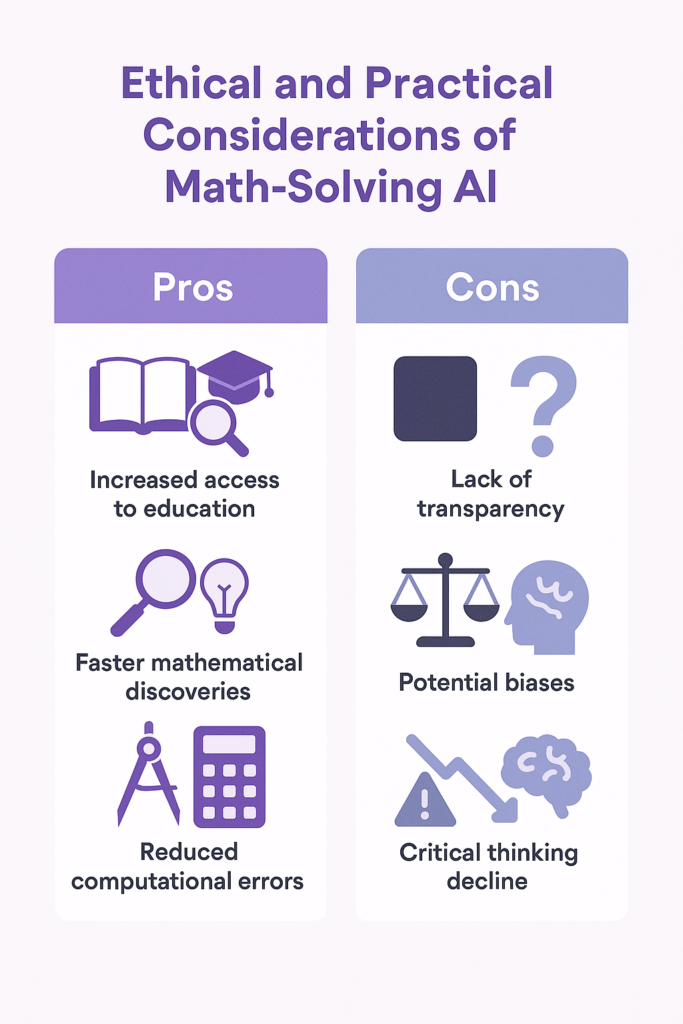
On the plus side, AI chips away at the traditional barriers in education. It opens the way for irrespective access to learning resources around the globe and can potentially usher in a speedier pace of scientific discovery. AI’s precision could also be a countermeasure against human errors in computation.
Can we then blindly lean on AI for all things math? Not quite. Several challenges lurk around the corner. We risk becoming complacently reliant on machines, for one. More concerning is the dark specter of the ‘black box’ problem, where AI’s inexplicable reasoning process raises questions about transparency.
Bias, too, can creep into the mix. If the training data is unbalanced or biased, it can feed skewed results, distorting the path to truth in mathematics. Perhaps the most crucial concern is the potential decrease in human critical thinking skills, if AI is used thoughtlessly, as a crutch rather than a helping hand.
So, tread with caution. AI holds the promise to unlock new horizons in the field of math, but we must not lose sight of its limitations and potentially disruptive consequences.
Decoding AI’s Potential in Mathematics
- AI can obliterate traditional educational barriers, offering global access to learning resources and potentially accelerating scientific discovery.
- Increased precision in calculations and a safeguard against human errors are definite pluses of embracing AI.
- The risks? Dependency on machines, lack of transparency, and potential bias. If we’re not careful, we could compromise our critical thinking skills.
- The ideal scenario? A synergistic relationship, where AI’s computational power is coupled with human creativity, forming a partnership that catapults the future of advanced math.
Not the End, Just the Beginning: AI’s Journey in Mathematics
AI’s journey into the realm of advanced mathematics offers exciting new vistas to explore. Each twist and turn presents more possibilities yet more complexities as well. Encourage these tools to earn their place in problem-solving and participate in their story of evolution. Interested in sharing your perspective? Got thoughts on how AI’s role will unfold in our mathematical future? Eagerly accepting comments and personal experiences below.